
Culture Discovery in the Shadow of a Crisis
Author: Alastair Mitchell-Baker
3 December 2020
Reflections from Tricordant webinar with Jacqueline Totterdell, Chief Executive, and Tom Kenward, Programme Director, Culture, Leadership & OD, St George’s University Hospitals NHS Foundation Trust. 25th November 2020.
The Culture Discovery Process
Jacqueline Totterdell set the context for this important work, one of the top three priorities for the St George’s Hospitals Trust Board. Tom shared how they had embarked on the culture discovery process using the NHS Improvement Culture and Leadership Programme.
A multi-disciplinary team of about 30 Culture Champions was recruited from across all levels in the Trust supported by a small core team with Alastair as an external expert resource. They were just starting to really get going in March 2020, when Covid struck. This had a massive operational impact on St George’s as a major teaching hospital in the epicentre of the first wave with over 120 critical care Covid patients at the peak.
After a six week or so pause during the worst of the crisis, the Culture Champions resumed the culture discovery process, improvising and adapting their approach to take account of the operational constraints at the time. Tom reported that they were still able to feedback to the Board, in line with the original timetable by the end of September, having engaged thousands of colleagues from across the Trust using 6 different diagnostic tools.
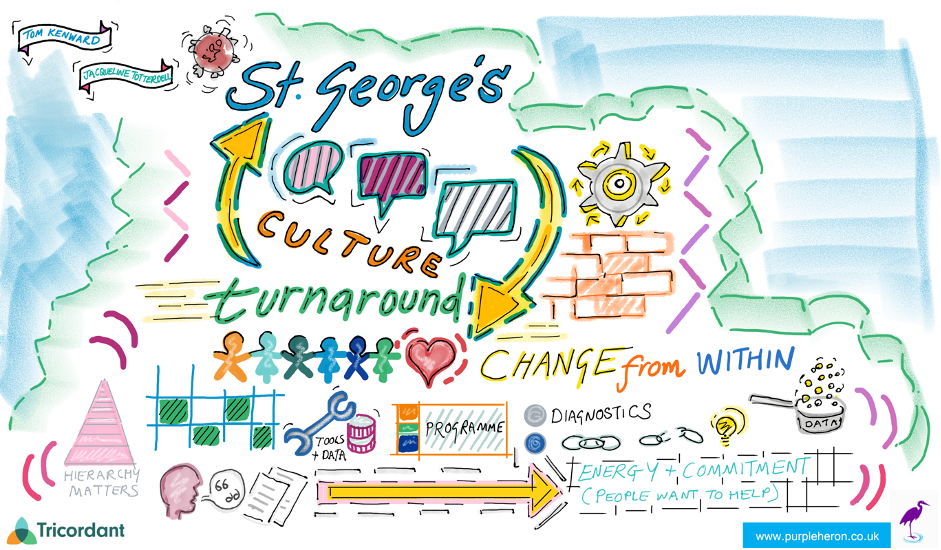
After Tom’s presentation there was discussion in plenary and a number of breakout rooms each involving at least one of the culture champions or core team.
Context of Crisis
One of the insights was that during the first wave of the epidemic, the unifying purpose of the urgent operational response helped to unify and align hospital staff. This meant that ways of working and collaboration across the organisation overcame some of the business as usual silos and fragmented working. Despite the very real safety concerns and extreme workload, staff also reported a sense of camaraderie and energy arising from reconnection with their core purpose and values. There was a heightened sense of team working and many examples of great improvisation.
Building from Crisis
We also heard how St George’s leadership had reflected and was learning from some of its own response in crisis. For example, it was recognised that processes could be simplified and streamlined, so that the ‘right thing was done’ rather than just ‘things were done right’. An example given was the streamlining of recruitment processes.
Another example of learning has been the development of the ‘village process’, based on the hospital wings and geography rather than specialty relationships, for the dissemination and discussion of the findings from the culture discovery process. This is an example of combining top down and bottom up communications and engagement which characterised collective leadership, at its best, during the Covid response, and has led to new relationships being formed.
Building Organisational Support for Change
There was recognition of the importance of genuine investment and commitment by the Board for the culture process, both the pace of the process, the space needed to allow widespread organisation engagement, and the courage to keep the process going during the pandemic. Processes such as discovery and development of culture inevitably take a long period of time, so attention needs to be paid to maintaining energy and momentum throughout for both organisational leaders and colleagues across the organisation.
Part of the success so far in St Georges has been combining multiple perspectives and approaches. Emphasis was put on both:
- Structured and quantitative data as well as unstructured and qualitative data. This was enabled through the use of natural language processing tools.
- Top down formal communications and village based informal communication (The ‘villages’ are the main building blocks, often with up to 2000 staff working within them.)
- Leadership of the work that is both embedded at a senior but still relatively hands-on. There’s a need for real ownership with the necessary authority. This creates an opportunity to build out around them so there is continuity and resilience as and when people move on.
- Culture discovery and experiential actions such as the trial of a culture pulse tool.
Conclusion
In summarising the webinar Dr Roger Greene highlighted the courage required by the Trust leadership and the Culture Champions to start and continue this journey through the challenge of the Covid crisis. This continued with facing up to the findings of the discovery process with ‘unvarnished messaging’ through imaginative improvisation.
Surely this is a good foundation for the long journey ahead to further develop the culture of St George’s in line with the aspirations of its staff and Board.