Southend, Essex and Thurrock Mental Health Strategy Case Study
Author: Alastair Mitchell-Baker
2 February 2024
The Challenge
The Southend, Essex, and Thurrock (SET) system’s mental health strategy required a refresh. Additionally, they recognised that their current strategy had not been fully implemented for a range of reasons, including the COVID-19 pandemic. However, they also understood that it was too easy to use that as an excuse, and there were other system operational issues to be resolved as part of the new work.
Tricordant was commissioned through a competitive procurement to provide support, advice and facilitation for the engagement, development and writing of a 5 year All Age Essex Mental Health Strategy for 9 statutory partner organisations including ECC, 2 unitary authorities, 3 ICBs, 2 NHS Trusts and Essex Police, working with a wide range of stakeholders.
The context for the review was complex and challenging with the ongoing Essex Mental Health Independent Inquiry set up to investigate matters surrounding the deaths and treatment of mental health inpatients across NHS Trusts and the statutory establishment and development of Integrated Care Boards and Partnerships, which are not coterminous with Upper tier local authorities. It was understood that there would be significant organisational, system and political challenges to overcome.
Our Approach
To develop the strategy, we worked with a steering group of system leaders. Over 6 months, we interviewed the leaders and held two system-wide workshops to obtain a clear sense of direction for the strategy. We held semi-structured conversations with over 100 individuals, groups or organisations representing those with lived experience. This included Mind and Healthwatch, smaller and more locally based organisations such as Trustlinks and Southend Association of Voluntary Services (SAVS) through, to very specific groups such as those representing Bangladeshi women and Black African and Caribbean men. We also engaged with professionals, practitioners and other stakeholders interested in, impacted by and influencing mental health across this complex geography, as below.
Our team, which included experts by experience, and experienced medical and nursing professionals, carried out research into the specific population needs by working with public health colleagues and local clinicians and professionals and by using data from the local Mental Health Joint Strategic Needs Assessment (JSNA) and key national and local data sources.
We co-developed with the steering group a vision “to promote good emotional and mental health for everyone, reduce health inequalities and to improve life outcomes for those with mental ill health, enabling them to recover and live well.” with a supporting ‘strategy on a page’ and an 18-page document summarising the key context, priorities and plans for delivery. This serves as a shared direction and cohering narrative for the three local Integrated Care Partnerships, covering:-
- Mid and South Essex
- North East Essex (part of the Suffolk and NEE ICS )
- West Essex (part of the Hertfordshire and West Essex ICS)
The Outcome
Gaining agreement across all the organisations and political systems was a challenge, and it took a great deal of time and effort with individual and group meetings, listening to everyone’s perspectives, and then finding a way forward that worked for all and was most definitely not a lower quality compromise. We completed the work with full agreement and acceptance of the vision and the strategic priorities, with all system partners signing up to do what they needed to do. Implementation work is currently underway.
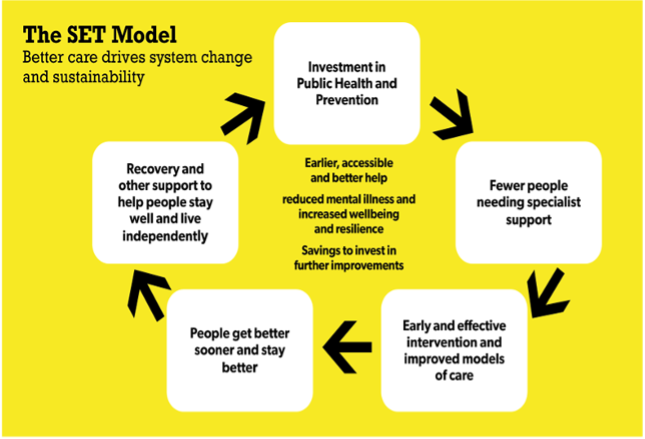
In parallel, we also facilitated and supported the development of a shared collaborative strategy implementation approach across the partners. This was a challenge given the diverse stakeholder contexts, population needs, and approaches to collaborative working. The ‘SET Model’ shown here demonstrates how collective actions can create a virtuous cycle of improvement in individual care and population outcomes. However, agreeing robust ways of working underpinned by trusted relationships is key to delivering the vision and strategy.